What Happens When a Wheelchair Enters the Room
A field guide to accessibility, belonging, and the strange ways humans behave.
A new chapter started the day Persephone came home.
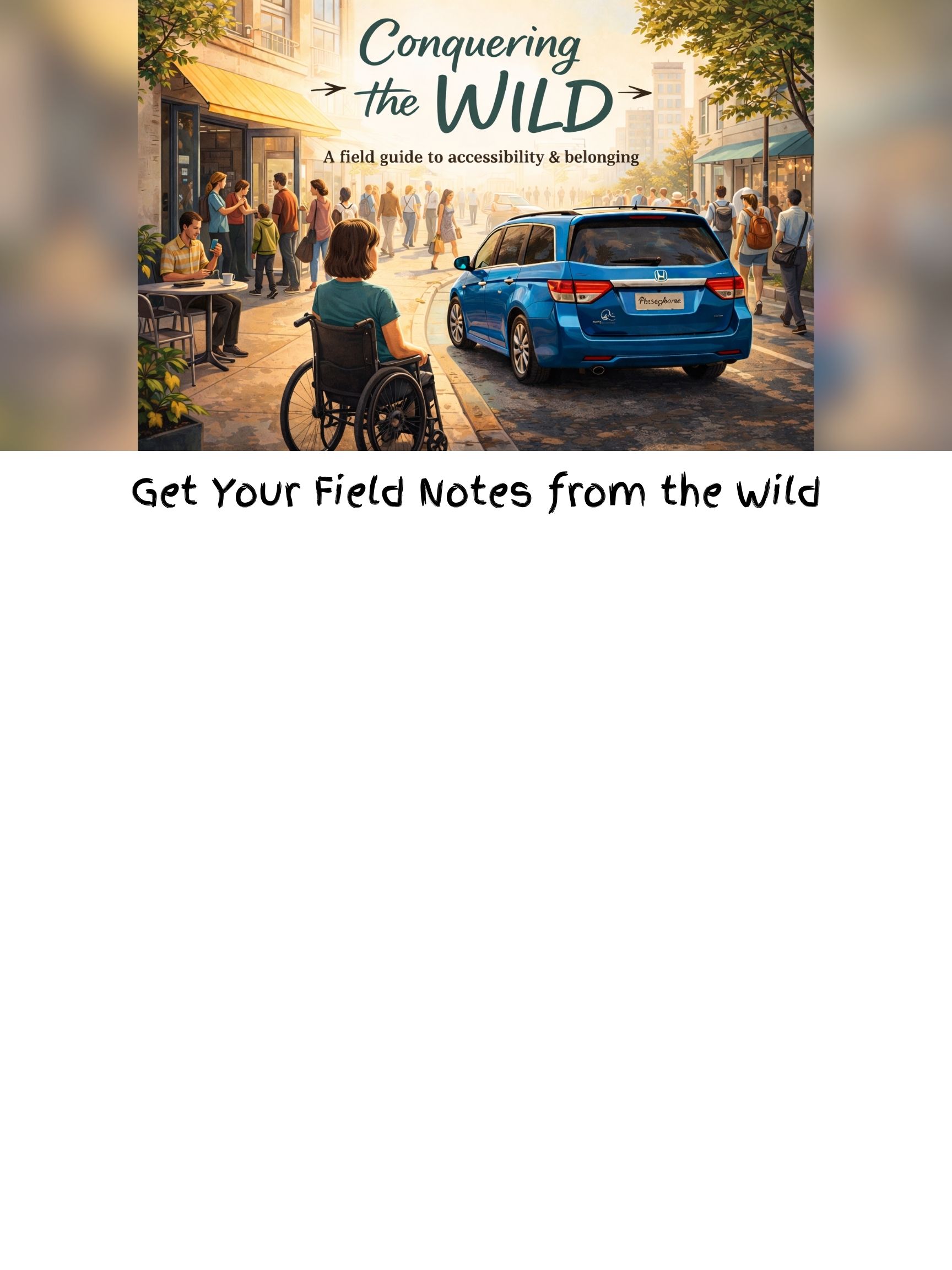
Persephone, for the record, is not a mysterious Greek goddess living in my garage. She’s my van. A beautiful, freedom-granting, hand-control-equipped Honda Odyssey that rolled into my life and quietly handed me something I had been missing for a while: independence.
Not the dramatic, movie-moment kind of independence people like to celebrate. The simpler kind. The everyday freedom of deciding you want to go somewhere… and simply going.
For the past months, getting anywhere meant coordinating rides, checking schedules, and depending on the kindness and availability of other people. Which I’m deeply grateful for — truly.
But let’s be honest, it also changes how often you leave the house. At some point you realize you’ve unintentionally become a bit of a hermit.
Interestingly, seasons like that have a way of revealing things. You notice the friends who quietly check in when you go a little M.I.A., and the ones who assume you must be off somewhere living your life as usual. It’s not necessarily good or bad — just one of those small truths life shows you when things slow down.
Persephone changed that.
Now I can grab my keys, roll down the driveway, and go wherever curiosity takes me. It’s a quiet kind of freedom, but it’s powerful all the same.
And with that freedom comes something else I didn’t expect: a renewed opportunity to observe humans in their natural habitat again.
Which brings me to something I’ve noticed again and again.
The moment a wheelchair enters a room, something shifts.
Sometimes it’s subtle — a half-second pause in a conversation or a quick glance that flickers away and then back again. Sometimes it’s more obvious. Someone suddenly becomes deeply interested in their phone. Someone else rushes forward with heroic enthusiasm to hold a door that was not, in fact, under immediate threat of collapse.
Most of the time, none of it is malicious.
It’s simply humans encountering something they’re not used to thinking about. And when people enter unfamiliar territory, the results can be awkward, kind, confusing, thoughtful, or occasionally a little absurd.
Honestly, it’s fascinating to watch.
Accessibility conversations often focus on things like ramps, parking spaces, elevators, and door widths. And those things absolutely matter. Physical access is important.
But accessibility isn’t just about architecture.
It’s about people.
It’s about what happens in that small moment when our assumptions bump into reality. The way people respond, the way they adjust, the way they try to help — or sometimes pretend nothing unusual is happening at all.
Over the past months, I’ve had a front-row seat to many of these moments. At expos, in restaurants, in elevators, in parking lots, and in all the everyday places where life unfolds.
Sometimes people are wonderfully kind.
Sometimes they’re hilariously awkward.
Sometimes they behave as though I have suddenly acquired full invisibility powers.
Humans are strange creatures.
Which is exactly why this blog exists.
Conquering the Wild is a place to explore accessibility, belonging, and the curious ways people behave when disability enters everyday spaces. Not with lectures and not with finger-pointing, but with curiosity.
Because the truth is that most people aren’t trying to be insensitive. They’re simply navigating something unfamiliar, and unfamiliar situations can bring out the most interesting parts of human behavior.
Think of this blog as a bit of a field guide.
Together we’ll notice the awkward moments, celebrate the thoughtful ones, and occasionally laugh at the ridiculous ones. And every once in a while Persephone and I will venture out to explore places that proudly describe themselves as “accessible.”
Sometimes they truly are.
Sometimes… well… let’s just say the word accessible can be used rather creatively.
Either way, we’ll take a look together — with curiosity, honesty, and maybe the occasional raised eyebrow.
Because awareness rarely begins with being told what to think.
It begins with noticing.
And once you start noticing these moments, you begin to see them everywhere. The tiny pauses. The quiet kindness. The uncertainty. The adjustments people make as they try to figure out how to interact.
Those moments tell us a lot about how we see each other.
And if you’re the kind of person who tends to notice things others overlook, chances are you’re already a bit of a misfit in the best possible way.
If that’s the case, you’re warmly invited to join us in the Home of Misfits – Open Living Room on Facebook — a space where curiosity, kindness, and perspective shifts are always welcome.
So welcome to the wild.
No shame.
No lectures.
Just awareness.
Because belonging isn’t automatic — it’s practiced.
— Sabine Mann, PhD
Founder, Happiness Matters Foundation
Join the Adventure